Why Mystery Creates Desire
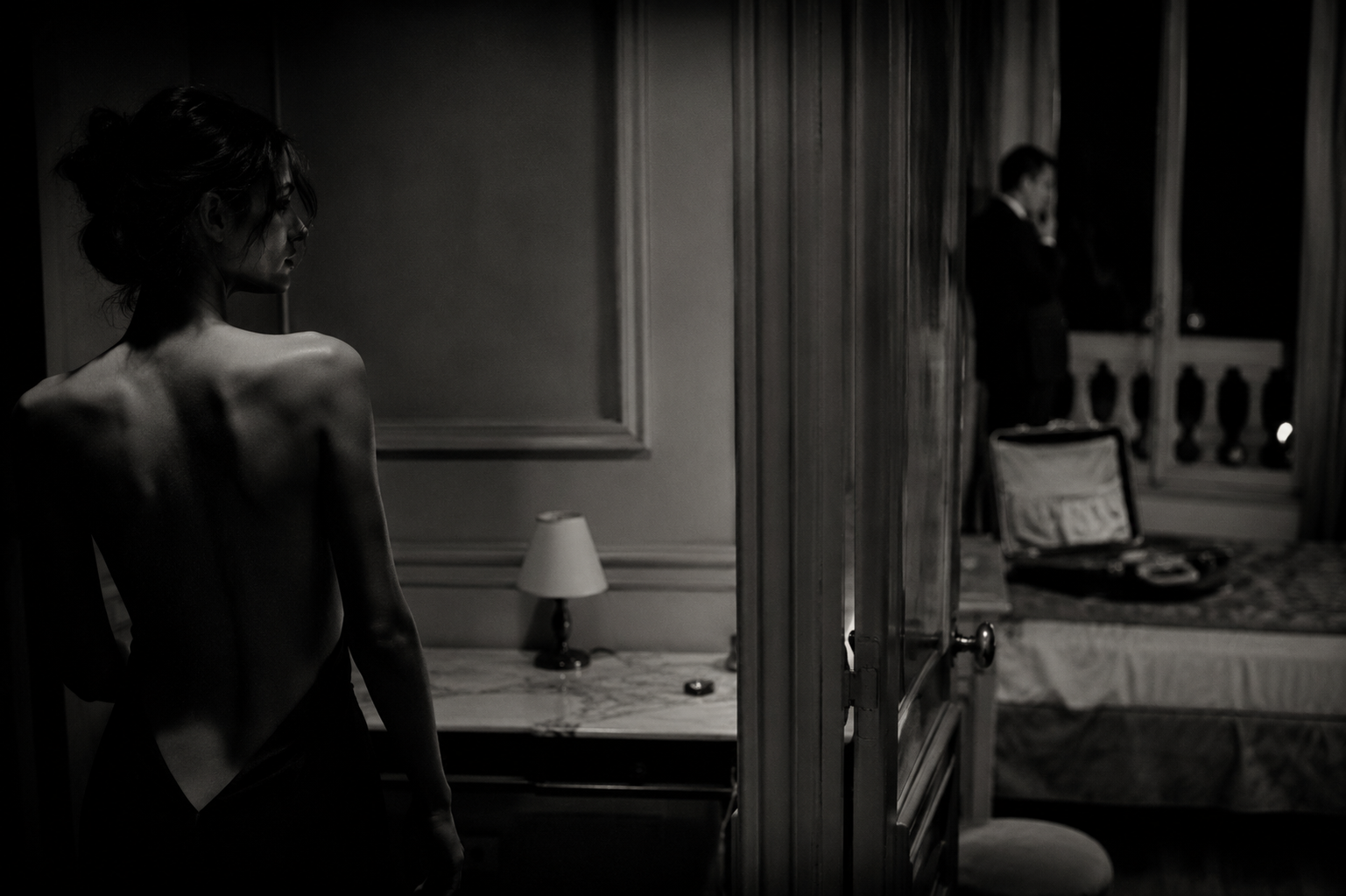
Black-and-white cinematic photograph by Alessia Moccia showing a woman seen from behind in a dimly lit room, with a blurred man in the distance and an open suitcase, creating a sense of mystery and unresolved narrative.
A few days ago, I was reading Helmut Newton's autobiography when I came across a sentence I couldn't stop thinking about.
“I still believe that the perfect fashion photograph is a photograph that does not look like a fashion photograph. It's a photograph that looks like something out of a movie, like a portrait, maybe a souvenir shot, maybe a paparazzi shot—anything but a fashion photograph.”
I read it twice.
Not because it was surprising.
Because it gave words to something I've believed for years.
The fashion images I remember the most never feel like fashion images.
They feel like fragments of a larger story.
As if I've walked into a room where something has just happened.
Or something is about to happen.
Someone is leaving.
Someone is waiting.
Someone knows something I don't.
That feeling—that tiny gap between what I see and what I don't—is where desire begins.
As photographers, we're often taught to reveal.
Show the clothes.
Show the beauty.
Show the location.
Show the product.
Explain the concept.
But the images that stay with me do the opposite.
They withhold.
They trust the viewer enough to let them complete the story.
I've started wondering why.
Part of the answer may come from psychology.
Incomplete experiences often stay active in our minds because we keep returning to them, looking for resolution.
Psychologists have described this tendency through what is known as the Zeigarnik Effect.
Maybe that's why mystery creates desire.
Not because we know less.
Because we imagine more.
I think this is something luxury has always understood.
The most memorable campaigns rarely explain themselves.
They don't shout.
They suggest.
They leave room for interpretation.
That's why, decades later, Helmut Newton's photographs still feel contemporary.
They are more than documents of fashion.
They are invitations to imagine another scene outside the frame.
Ironically, we're moving in the opposite direction.
Today's images are incredibly good at showing everything.
Every detail is sharp.
Every surface is perfect.
Every idea is immediately understandable.
Especially with AI, it's becoming easier than ever to generate flawless pictures.
But perfection isn't the same as fascination.
The more an image explains, the less I find myself thinking about it afterwards.
The images I can't forget are usually the ones that leave one question unanswered.
Who is she waiting for?
Why is she looking away?
What happened just before this moment?
What happens next?
Maybe that's why mystery has become more valuable than ever.
In a world where almost anything can be generated, restraint becomes an act of authorship.
Knowing what not to show.
Knowing when to leave space.
Knowing that sometimes the most beautiful part of an image isn't inside the frame at all.
It's the story the viewer quietly finishes in their own mind.