Why We Want What We Can’t Have
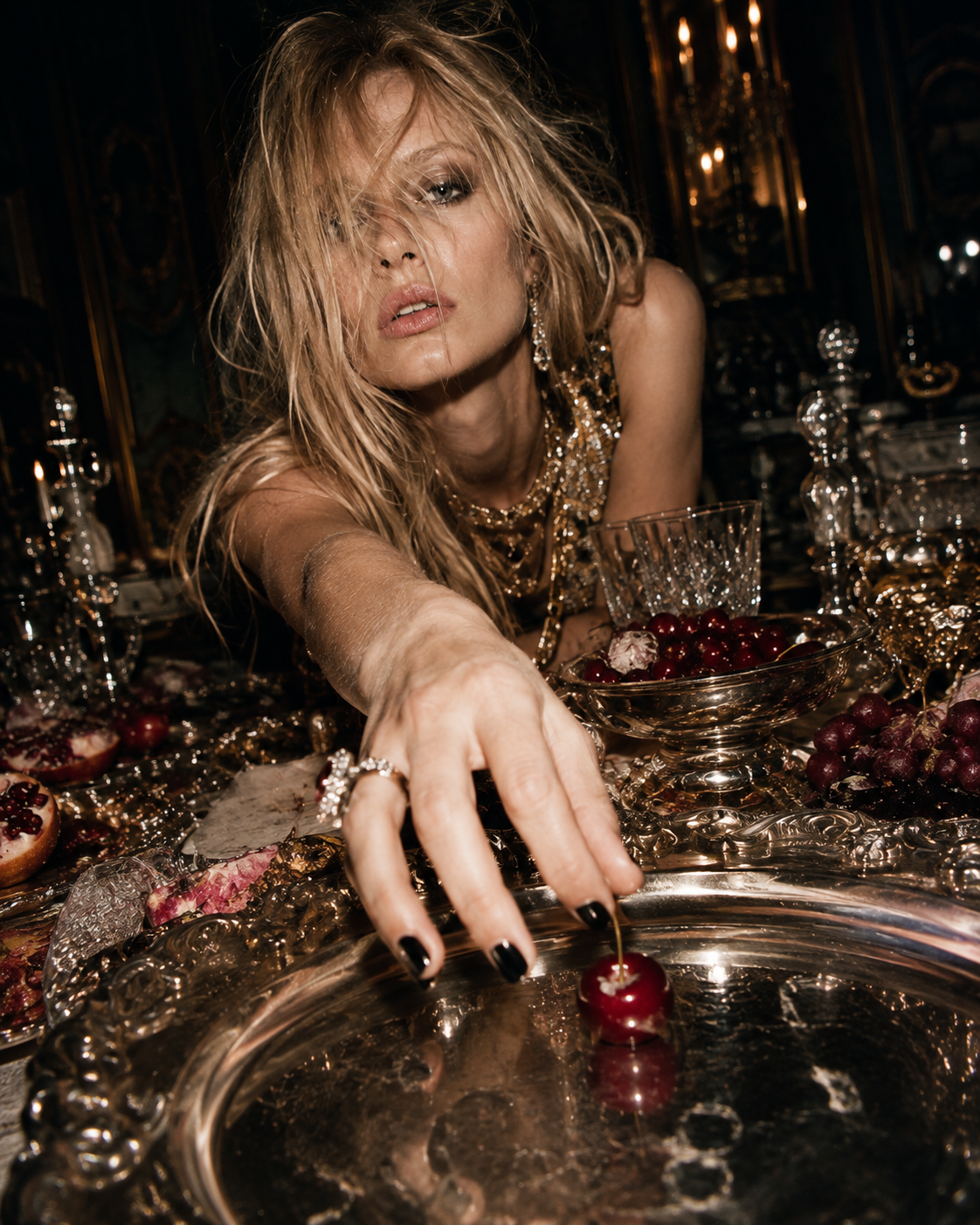
Fashion editorial by Alessia Moccia exploring scarcity and desire: a woman reaches for the last cherry on a silver platter in a decadent luxury setting.
Dopamine, desire and the irresistible attraction of almost.
A while ago, I read Dopamine Nation by Anna Lembke, and something in it stayed with me.
Lembke is a Stanford psychiatrist who studies addiction. But one of the stories I remember most was about her own.
She writes openly about becoming compulsively absorbed in romantic novels, eventually moving towards increasingly erotic ones. At some point, she noticed she wasn't even finishing one before searching for the next.
I loved that confession.
There was something wonderfully human about an addiction expert catching her own brain doing exactly what brains do.
And I recognised something too.
Not the novels.
The desire for the next thing.
That strange moment when an object gets into my head. I didn't need it. Ten minutes earlier, I didn't even know it existed.
And now?
I want it.
So I started wondering why.
Before pleasure comes anticipation
We often hear dopamine described as the “pleasure chemical.” The neuroscience is more nuanced.
What fascinated me is how involved dopamine is before the reward arrives — in motivation, anticipation and learning what might be rewarding.
The brain begins responding to cues: seeing the object, imagining it, anticipating having it.
In a sense, part of the experience has begun before we possess anything.
And imagination has one wonderful advantage over reality:
Reality eventually has to deliver. Imagination doesn't.
Then make that object difficult to obtain and something else enters the picture.
There is only one.
It may disappear.
Someone else may get it.
Hello, FOMO.
Research suggests that scarcity can influence perceived desirability and value under certain conditions. It isn't automatic — obvious manufactured scarcity can simply feel manipulative — but the possibility of losing access changes the equation.
And that made me think about luxury.
The waiting list.
The couture piece made once.
The fragrance that is difficult to find.
The invitation that may or may not arrive.
Perhaps anticipation is one of luxury's invisible materials.
Silk. Leather. Gold.
And waiting.
Then AI gave us almost everything
After more than twenty years in fashion photography, I was used to limitations.
The impossible location. The dress that couldn't travel. The light disappearing.
AI moved many of those walls.
Today I can create places that have never existed, turn a perfume into architecture, or make an image that previously lived only in my imagination.
I love that freedom.
But it leaves me with a curious question:
If we can create almost anything, instantly, what happens to anticipation?
Another image is always possible. Another version. Another world.
Maybe the challenge isn't always creating more.
Maybe it's knowing which one to keep.
The last cherry
That's why I created the image for this Fragment.
An extravagant table. Silver, crystal, flowers, fruit, jewelry.
A woman surrounded by abundance.
And one last cherry.
But my favourite part isn't the cherry.
It's the tiny space between her fingers and it.
She hasn't got it yet.
For another second, it can still be perfect.
Maybe it will be extraordinary.
Maybe it will just be a cherry.
But right now?
She still wants it.
Perhaps that's the deliciously annoying thing about desire.
Sometimes almost is the best part.
— Alessia Moccia
Photographer, Creative Director, AI Filmmaker & AI Artist
Founder & Creative Director, E-UPHORIA STUDIO — New York