The Art of Removing
What Franco Fontana taught me about seeing in the age of AI.
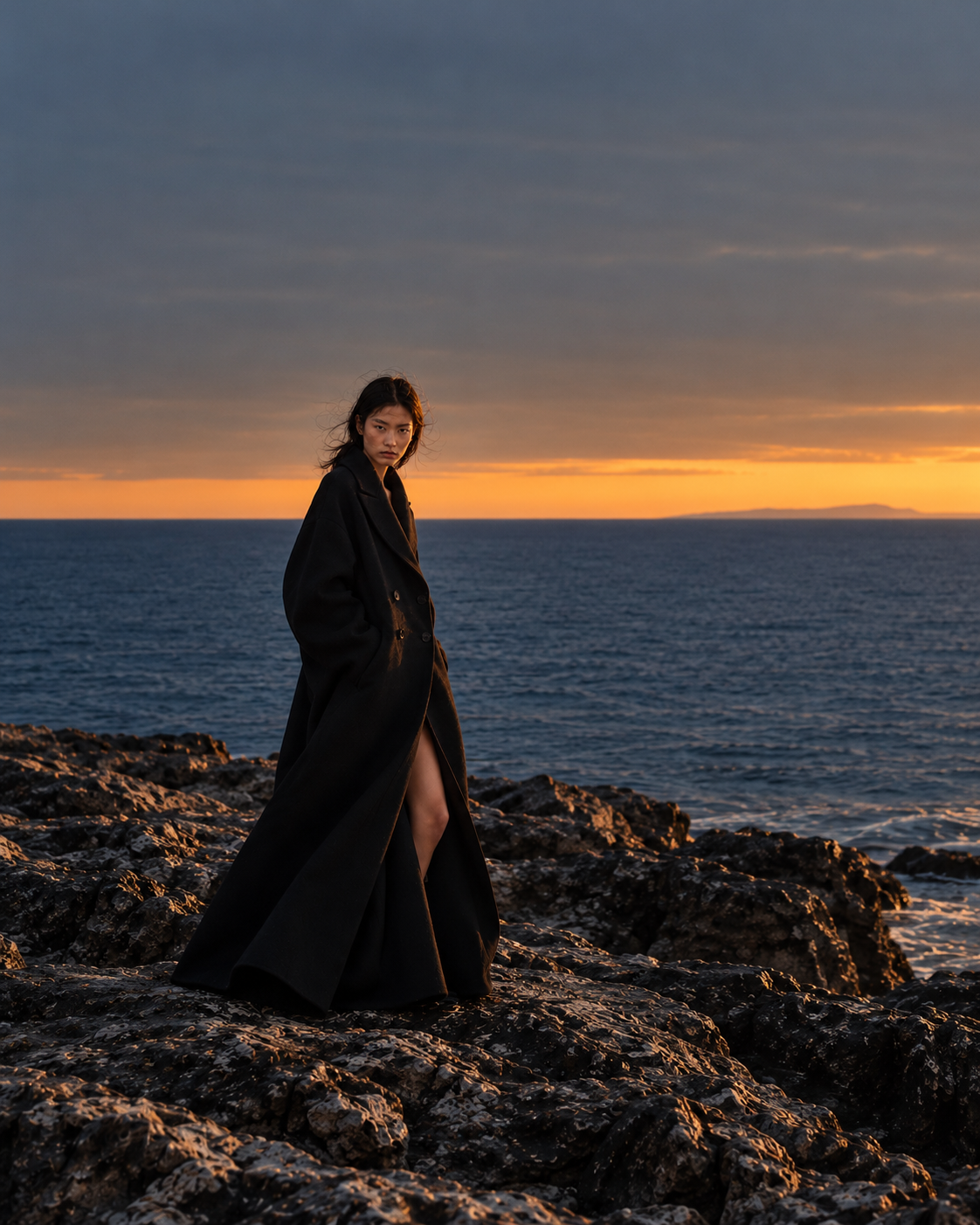
A fashion image by Alessia Moccia: a woman in a sweeping black coat stands on a rocky coastline at dusk, framed by horizontal bands of dark rock, deep blue sea, glowing orange light and a muted grey sky.
Lately, I’ve been watching documentaries about some of the great Italian photographers.
Franco Fontana made me think about something deceptively simple.
To see more, sometimes you have to remove more.
Fontana looks at a landscape and finds geometry.
A hill becomes a curve.
A field becomes a block of colour.
A horizon becomes a line.
Nature is still there, but almost everything unnecessary has disappeared.
What fascinates me is not simply his extraordinary use of colour.
It is his ability to recognize what matters — and eliminate the rest.
He doesn’t need to add anything to make reality extraordinary.
He subtracts.
And that made me think about my own work.
As a photographer, I’ve always been interested in framing, light, composition and the relationships between things.
What stays outside the frame can matter as much as what stays inside.
Generative AI introduces an interesting contradiction.
Suddenly, I can add almost anything.
An impossible landscape.
An enormous chandelier.
A moon where there wasn’t one.
I can construct an entire photographic world or direct a film without many of the physical limitations of a traditional set.
The possibilities are extraordinary.
And sometimes that is precisely the problem.
When everything becomes possible, it becomes very easy to add one more thing.
Another detail.
Another movement.
Another beautiful object.
Until the image loses the reason it existed in the first place.
Looking at Fontana’s photographs reminded me that an image does not become stronger because it contains more information.
Sometimes it becomes stronger because someone dared to remove it.
This doesn’t mean I want images to become minimal.
I love excess. Drama. Elaborate lighting. Strange combinations. Things where they should not be.
But even excess needs editing.
A chandelier in the middle of a desert works partly because there is almost nothing around it.
The same happens in film.
One gesture can be stronger than ten.
A pause can do more than an effect.
A single movement can carry an entire scene.
AI gives me the freedom to create more.
My eye has to decide what deserves to remain.
Perhaps that is why looking at photographers like Fontana feels especially relevant now.
The tools have changed enormously.
The problem of seeing has not.
To recognize the image.
To know what belongs.
To know what distracts.
To know when to stop.
Those decisions are still human.
AI gives me the freedom to add almost anything.
Fontana reminded me of the freedom to take it away.