Lately, I’ve been thinking about ugly chairs.
It started while I was looking again at Martin Parr’s photographs: beaches, tourists, bad food, awkward bodies, plastic chairs. So much of what makes those images interesting was already there, waiting to be noticed.
That’s precisely what makes them interesting.
Parr came from documentary and street photography, and when he later moved into fashion, he brought that eye with him: the ability to notice the ordinary, the awkward, the slightly wrong.
And it made me think about luxury today.
Ask AI to create luxury, and it knows exactly what to do: marble, immaculate interiors, perfect skin, expensive flowers, golden light. Everything beautiful. Everything exactly where it should be.
And I couldn’t help but wonder:
Does luxury need something wrong?
A Chanel bag inside a five-star hotel? Beautiful. Expected.
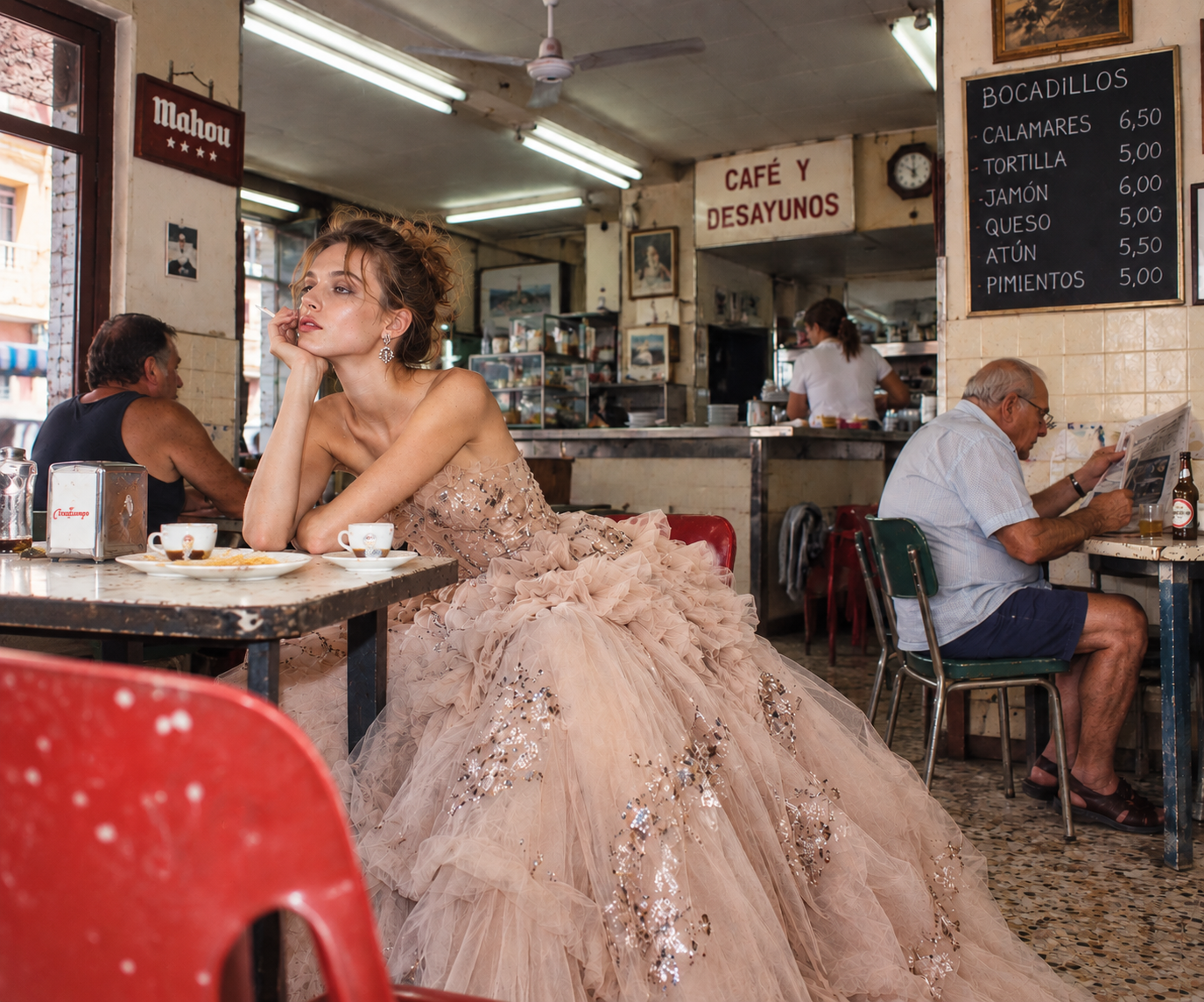
Put it on a faded plastic chair outside a run-down seaside restaurant, and suddenly I’m interested.
A couture dress at Versailles? Of course.
The same dress in a weathered café under fluorescent lights? Now I want to know who she is.
A perfume bottle on marble is advertising.
A perfume bottle beside the remains of breakfast in a faded motel room?
What happened here?
Maybe desire needs friction.
I probably think this way because I didn’t begin with AI either.
I came to it after years of traditional photography — street photography, fashion, real people and real locations — learning to think through lenses, light and composition.
Photography taught me to look before I learned to generate.
With a camera, you don’t invent the wrong chair. You notice it.
Someone enters your frame. The light changes. A strange gesture lasts half a second. Something you would never have art-directed suddenly becomes the reason the photograph works.
Reality gives you accidents.
AI gives you control.
And perhaps that’s the strange challenge of working between both worlds.
AI can make everything perfect. The wall improves. The chair becomes designer. The skin becomes flawless. The flowers multiply.
Even the breakfast starts behaving itself.
But my photographic instinct often wants to put some reality back in.
Give me the wrong chair.
Leave the cheap glass on the expensive table.
Let her eat the French fries.
Put couture somewhere couture has no business being.
Not because ugly is interesting by itself. It isn’t.
The contradiction has to tell us something — about taste, class, aspiration, identity, desire.
Parr could wait for those contradictions to appear in front of his camera.
With AI, we have a different responsibility: not to perfect them out of existence.
Because in a world where we can manufacture perfection in seconds, perhaps perfection is becoming the least interesting thing we can make.
So now, when an image is beautiful but leaves me cold, I ask:
What should I ruin?

 Alessia Moccia