On Andy Warhol, Rick Rubin, and the curious business of making art.
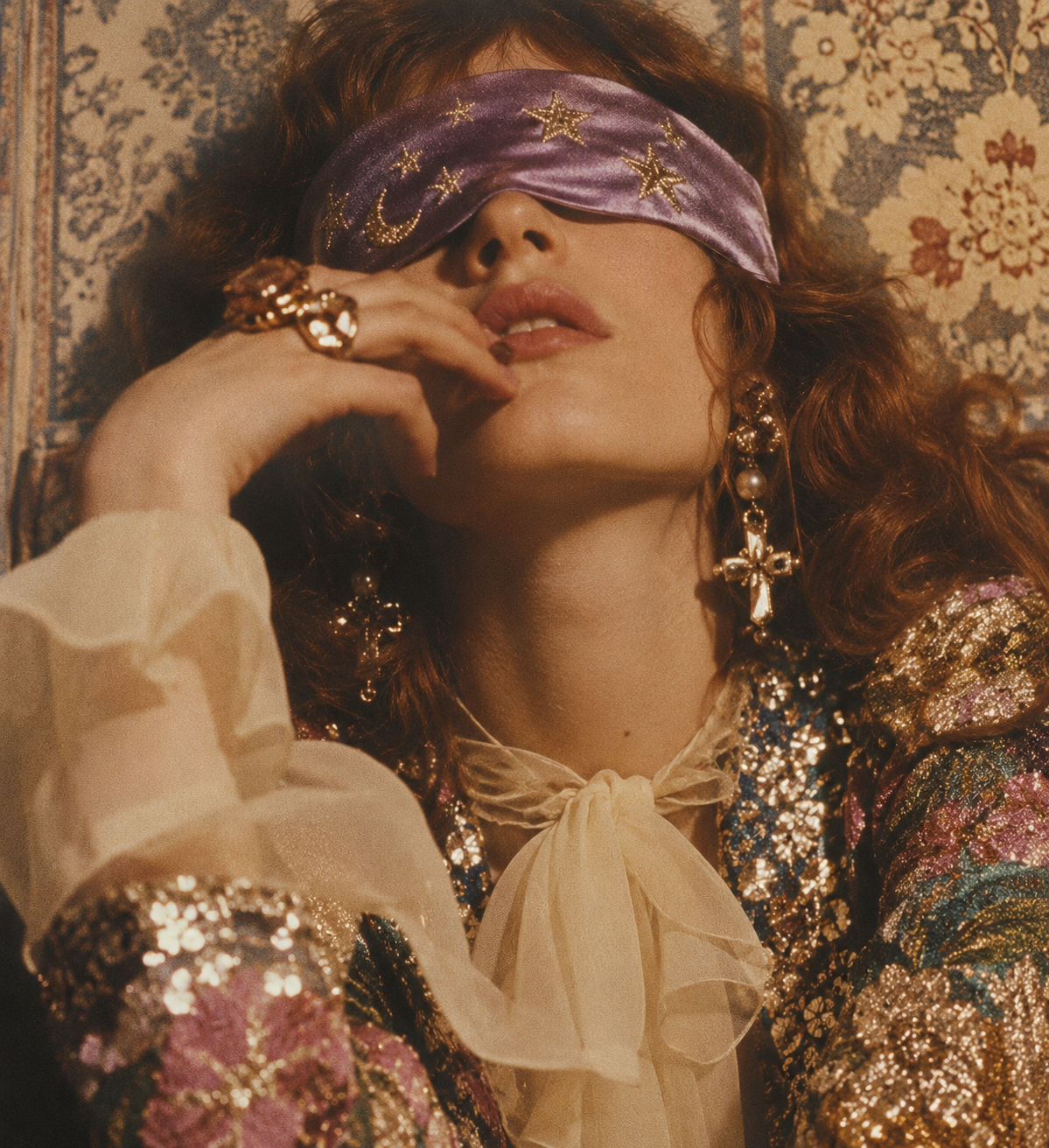
A glamorous woman reclines against a richly patterned backdrop, wearing a lilac satin sleep mask embroidered with stars and a crescent moon. Her sequined floral jacket, sheer bow blouse and oversized gold jewellery create a decadent, theatrical mood, while her covered eyes introduce a sense of distance and deliberate withdrawal. The image feels intimate, cinematic and slightly surreal — a fashion portrait about looking away, control and the choice not to see everything.
I was listening to Rick Rubin in conversation with Steven Bartlett on The Diary of a CEO when something he said made me smile.
They were discussing artificial intelligence, creativity and whether an artist needs to physically execute every part of an artwork.
Rubin brought up Andy Warhol.
Warhol had a Factory. Quite literally.
He worked with assistants, photographs, silkscreens and mechanical reproduction. Some of his most recognizable works were produced through processes carried out by other people.
And yet, they’re unmistakably Warhol.
Rubin’s point was simple: the creative vision doesn’t necessarily belong to the person physically applying the paint.
I found myself thinking about how familiar that idea is in fashion.
For decades, I worked as a stylist and fashion director before moving into photography and filmmaking.
Fashion has always been collaborative.
A designer doesn’t necessarily sew every garment. A fashion director doesn’t personally execute every element of a production. A photographer works alongside stylists, makeup artists, set designers and retouchers.
Nobody finds this particularly shocking.
We understand that an image can emerge from many hands while still expressing a distinctive point of view.
The curious case of Dior
Recently, Dior’s holiday film became the subject of debate after viewers pointed to visual inconsistencies and questioned whether AI might have played a role in a production the house described as hand-drawn.
I understand the importance of transparency. If something is described as handmade, the description should be accurate.
But I was struck by how quickly the conversation shifted from the film itself to the tools that might have been used.
We’ve spent decades looking at fashion photographs transformed through digital retouching.
We’ve accepted elaborate composites, impossible locations and faces that bear only a passing resemblance to the people photographed.
Of course, generative AI introduces new questions, particularly around authorship, training data and creative labour.
Those questions matter.
But I wonder whether we’re sometimes mixing up two different conversations: how an image was made, and whether the image is any good.
A badly rendered hand is a production mistake. It isn’t an artistic philosophy.
A point of view
What I found most interesting about Rubin’s conversation was his belief that an artist’s point of view remains essential, regardless of the tools available.
That’s something I recognize in my own work.
My career has moved through styling, fashion direction, photography and now AI filmmaking.
The processes have changed enormously.
But my interests haven’t changed nearly as much.
I’m still drawn to particular colours, silhouettes, gestures, faces and atmospheres. I still know when something feels right to me, and when it doesn’t.
Sometimes the process involves a camera and a team. Sometimes it involves generative AI. Often it involves several techniques working together.
I don’t think every new technology automatically produces better art.
Warhol’s Factory certainly didn’t guarantee that everything coming out of it would be extraordinary.
What made his work interesting was what he chose to do with the possibilities available to him.
And perhaps that’s the part of the conversation I’d like to hear more often.
Not simply what someone used to make an image.
But what they saw in the first place.
Referenced conversation: Rick Rubin interviewed by Steven Bartlett, The Diary of a CEO, September 2026.